Disposal
The County Landfill Will Not Take You
The usual advice is to compare a dumpster against a few trips to the dump in a borrowed pickup. In this county that comparison does not exist, and almost nobody knows it until they turn up.
⭐ The sentence that surprises people
Almost every article written about dumpster rental, anywhere in the country, contains the same comparison: weigh the cost of a container against the cost of a few trips to the dump in a pickup.
It is not a technicality or a fee difference. Commercial status is verified at the fee booth, and a private individual with a pickup full of renovation debris is not what the gate is for.
This is genuinely unusual, and it reshapes the whole decision. In most markets a dumpster is the convenient option. Here, for most of what comes out of a house, it is close to the only one.
What commercial-only actually means at the gate
The facility runs Monday to Saturday, from seven in the morning until four in the afternoon, for commercial haulers. There is a further window after that for transfer trucks only.
Commercial status is confirmed at the fee booth with documentation — a business license or a current tax return — or through the county's deferred payment account arrangement. In other words, it is a check on who you are, not merely on what you are carrying.
⚠️ The practical consequence: turning up with a legitimate load and no commercial standing does not get you a higher price. It gets you turned around, having spent the morning loading and driving.
⚠️ So what are the real options?
For a householder in Santa Ana with a genuine volume of material, the honest list is short.
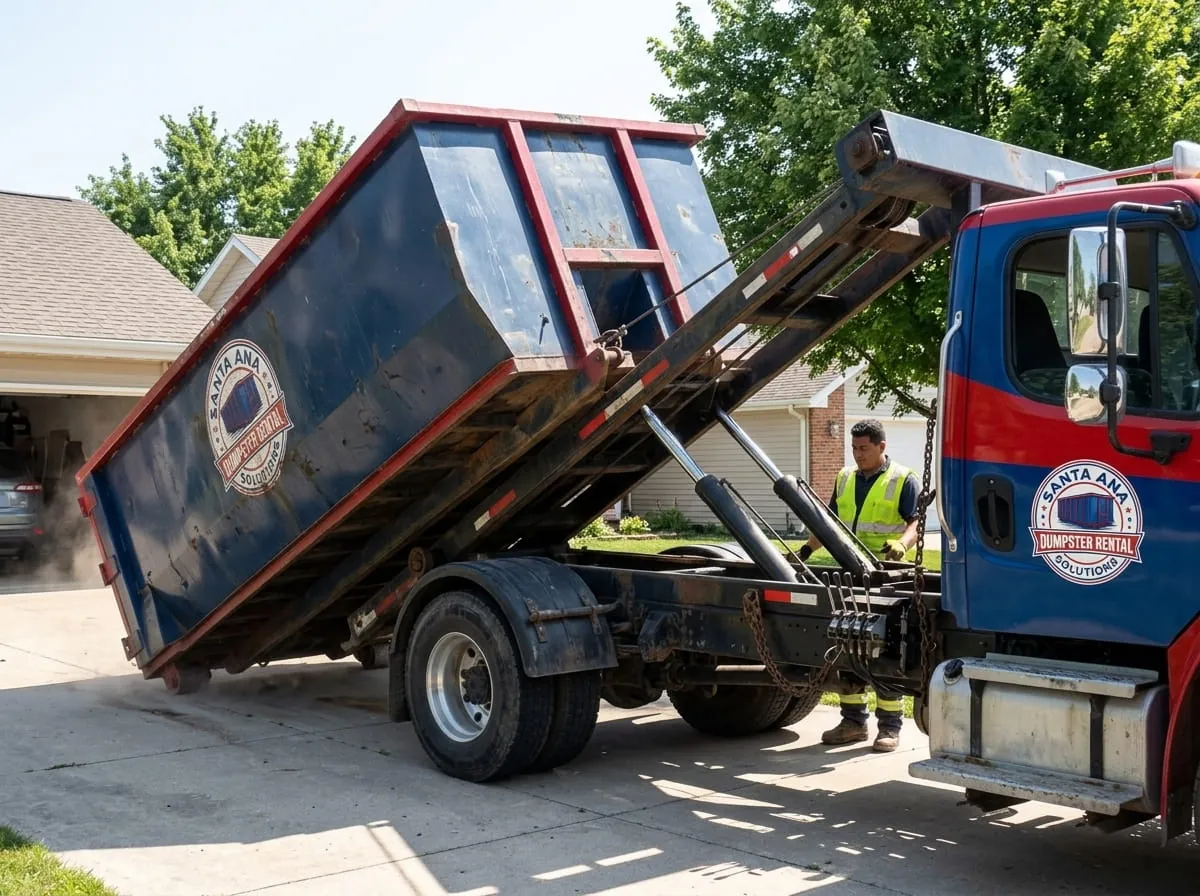
A roll-off container. The hauler has commercial standing, the material goes to a facility that will accept it, and you never touch the question. This is why containers are the default here rather than a luxury.
The City's own programs for the material they are designed for. Santa Ana runs neighborhood cleanup and large-item collection arrangements, and if what you have is a sofa and a mattress rather than a renovation, that is the cheaper route and it already exists.
A private transfer station or recycling facility that does accept self-haul. Some do, with their own hours, rules and pricing. If you are going down this road, ring ahead and confirm before you load, because the rules differ facility to facility.
A junk removal service for small volumes where you want the labor included.
What is not on the list is the thing most people assume is on it.
The borrowed-pickup arithmetic nobody finishes
Even where self-haul is possible, the sums rarely work, and it is worth doing them once properly.
A pickup bed holds roughly two to three cubic yards of loose material if you stack it well and do not overload the suspension. A 20 yard container is therefore something like seven to ten pickup loads.
Each of those is a load-up, a drive, a queue, an unload and a drive back. Call it an hour and a quarter if everything goes smoothly, which across eight loads is a very long day and most of a tank of fuel — assuming you have a truck, and assuming the facility will take you, which here it will not.
Set against that, a container sits on the driveway and you load it when you have twenty minutes. The reason this comparison appears in every article is that it is usually close. In this county it is not close.
⭐ Where your container material actually goes
Worth knowing, because on a permitted job it is the thing you will be asked to document.
Material from a roll-off generally goes to a facility that sorts mixed construction and demolition debris and recovers the recyclable fraction, rather than straight to a landfill face. OC Waste & Recycling publishes a list of approved C&D diversion facilities for exactly this reason — because California's 65% diversion requirement means the destination has to be one that actually recovers material.
Clean single-material loads go further still. Clean concrete, clean metal and clean green waste all have their own recovery routes and are both cheaper to dispose of and better for a diversion figure.
If your job needs documentation, say so when you book and ask for weight tickets. That is a normal request and it should get a straight answer.
⚠️ What this means for a weekend cleanout
The practical advice for an ordinary Santa Ana household clearance:
Do not plan around trips to the dump. It is the single most common wrong assumption in this market.
Right-size one container rather than under-ordering. Because the overflow option — a couple of pickup loads to finish off — is not available, the cost of guessing small is a second haul rather than an afternoon's driving.
⚠️ Separate the things that cannot go in before you start, not at the end. Paint, batteries, electronics and anything with refrigerant have their own routes and none of them is the container.
Use the City's large-item collection for what it covers. If the job is really three pieces of furniture, you may not need a container at all, and we would rather tell you that than rent you one.
The things that still have their own route
Whatever you do with the bulk of the material, these are handled separately everywhere in California:
Paint. California runs a statewide paint stewardship program with drop-off sites at participating retailers. Leftover architectural paint goes there, not in the container.
Electronics. Televisions, monitors and computers are covered by the state's e-waste rules and have dedicated collection.
Batteries of every kind, including the household ones.
Fluorescent tubes and lamps, which contain mercury.
Appliances with refrigerant — fridges, freezers, air conditioning units. The refrigerant has to be recovered by someone qualified before the shell is scrap.
Tires and motor oil, both with their own long-standing routes.
Planning a job around it
Once you accept that self-haul is not the fallback, the planning gets simpler rather than harder. Decide the volume honestly, book the container that covers it, pull the hazardous and electronic items out first, and use the City's own services for the furniture-and-mattress end of the job.
Tell us what the material is when you call. The single most useful thing we can do on a Santa Ana job is stop someone ordering a container that is too small on the assumption that they will finish the last of it themselves — because here, they cannot.
Need a container in Santa Ana?
Call and describe the job. Three minutes on the phone gets you a size recommendation, a flat rate and a delivery window — and we will tell you if a smaller, cheaper container is the right answer.
Call (714) 360-0701