
Placement
Narrow Lots, Big Trees and Period Debris
This city's housing splits hard down the middle: 1920s bungalows on narrow lots under heavy canopy, and 1960s tracts with wide concrete. The same container does not suit both.
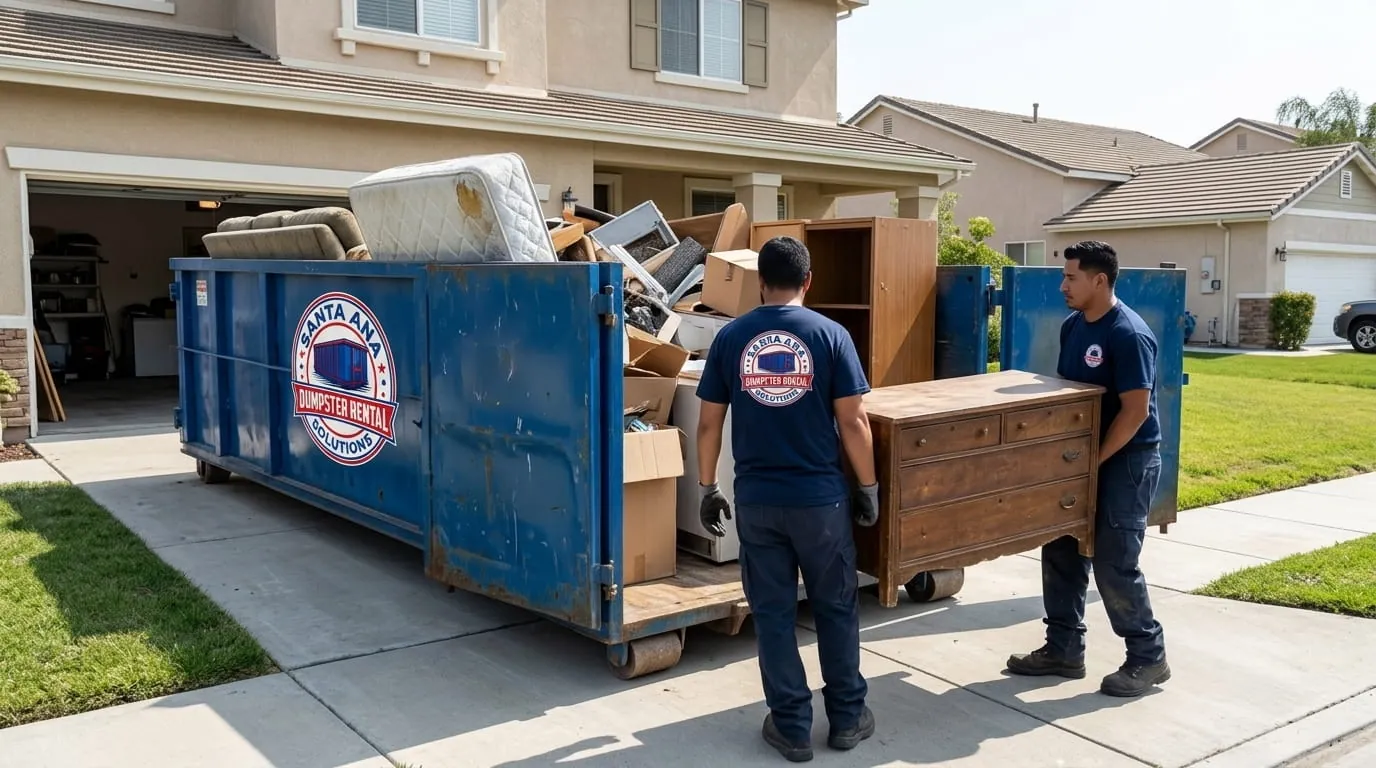
⭐ One city, two completely different jobs
Santa Ana is dense, flat and almost entirely built out, which means nearly everything that happens here is renovation rather than new building. But the renovations divide sharply, and the dividing line is the age of the house.
A 30 yard container is routine in one half of this city and impossible in the other, and the distance between them is about four miles. Knowing which half you are in is most of the sizing decision.
The historic half: what actually constrains you
Three things, in roughly this order.
Driveway length and width. Pre-war lots here were laid out for a single car, and many driveways are both narrow and short, running down the side of the house to a detached garage at the rear. A container has to sit in front of that, not in it.
Street width. Several of the historic districts have genuinely narrow streets with parking on both sides. The truck needs room to line up square to the driveway and to lift clear.
Overhead. Covered in its own section below, because it is the one people forget.
⚠️ The practical result is that in Historic French Park, Heninger Park and much of Washington Square, the honest answer is a 10 or 15 yard. We would rather tell you that on the phone than send a truck that has to leave again. A 15 yard holds considerably more than people expect, and two 15s that both deliver beat one 30 that cannot.
⚠️ The tree canopy decides more than the driveway
This is the single most underestimated constraint in the historic districts, and it is worth being precise about why.
A roll-off is not lowered gently into place. The truck tilts its bed and rolls the container off the back, which means that for a few seconds the leading end of the box is well above its resting height. On a 30 yard that is a lot of vertical space.
Floral Park, Washington Square and the streets around them have deep mature canopy — that is a large part of what makes them desirable. Branches that clear a car by a comfortable margin will not clear a tipping container.
⚠️ So when you call, tell us about the trees. Specifically: is there a branch over the driveway, roughly how high, and is there a clear run from the street. That one answer frequently changes both the container we send and where we put it, and it is far better settled on the phone than in your front garden.
The same applies to anything else overhead — service drops to the house, a carport roof, an arbour over the drive.
Period debris weighs more than you think
Older houses do not just constrain the container. They fill it faster.
Plaster and lath is the big one. A pre-war interior wall is wooden lath with plaster pushed through it, and it is dramatically heavier than the same area of modern drywall. A full-house plaster removal will reach a weight limit in a container that looks half empty.
Clay and concrete tile roofing is common on the Spanish Colonial Revival homes in Wilshire Square and across the historic districts, and it runs several times the weight per square of asphalt shingle. A tile tear-off is a 10 yard job, part-filled, and often more than one of them.
Old-growth timber is denser than modern framing lumber.
Stucco repair debris is dense in the same way plaster is.
And one caution that is not about sizing at all: houses of this age can contain asbestos and lead paint. If you suspect either, stop and have it tested. Neither belongs in a container, and neither is worth guessing about.
⭐ The post-war half: wide, flat and easy
South and west of the center the picture reverses almost completely.
The 1950s to 1970s tracts in Sandpointe, Santa Anita, Madison Park, Riverview West and Cornerstone Village were built with wide concrete driveways, straight approaches and street trees that are either younger or set further back. Placement here is genuinely simple, and a 20 or 30 yard goes down without much thought.
The debris is lighter too. Drywall rather than plaster, asphalt shingle more often than tile, modern framing lumber. The same size house produces a lighter load.
So the sizing advice inverts: in the post-war tracts, the risk is ordering too small and paying for a swap you did not need. A 20 yard is the sensible default for a reroof or a full remodel, and the 30 is there when the job includes a garage or an addition.
⚠️ When the only option is the street
Sometimes, particularly downtown, there is genuinely nowhere on the property.
A container on a public street or right-of-way in Santa Ana is not the same as one on your driveway. Work occupying the public right-of-way — including lane closures — goes through the City's Public Works Agency, Development Engineering, with plans submitted electronically through the City's plan-check system.
⚠️ That is a lead time, not a formality. If street placement is likely, raise it at the first conversation rather than the day before, and expect to describe how traffic and pedestrians get past.
A container in the street also needs to be visible after dark. Reflective marking is standard and we fit it.
Protecting the surface you are placing on
Whichever half of the city you are in, we put timber down under the wheels and rails as standard. It is not an upsell and it is not optional on our side.
On original pre-war concrete — which is often thinner and older than it looks — boards spread the load across a much larger area. On pavers or decorative concrete they prevent the point loading that cracks them. On asphalt they prevent indentation, which matters more on a hot day than a cool one. And on plain modern concrete they prevent the scuffing and rust marking a steel container can leave.
If your driveway is anything other than ordinary concrete, say so when you book so we bring enough timber.
Getting it right on the first call
Four things get you the right container first time, and they take about a minute to say.
The neighborhood, or just the street. The approximate age of the house. What the material is — plaster, tile and concrete all change the answer. And whether anything overhangs the driveway.
From that we can usually tell you the size, whether it will place, and whether you are looking at one haul or two. In a city this sharply divided between 1920s and 1960s housing, those four answers are worth more than any amount of guessing from a size chart.
Need a container in Santa Ana?
Call and describe the job. Three minutes on the phone gets you a size recommendation, a flat rate and a delivery window — and we will tell you if a smaller, cheaper container is the right answer.
Call (714) 360-0701