Cleanouts
An Estate Cleanout, Room by Room
Clearing a family property is slow, emotional work with a hard logistical core. An order of work makes it manageable — and there are two local traps worth knowing first.
Before anything is moved
Estate work differs from every other kind of clearance, because the logistics are the easy part.
Three things are worth settling before a single box is lifted.
Authority. Make sure the person directing the clearance has standing to do it. If the estate is in probate, or there are several beneficiaries, agreeing in writing who decides prevents the worst kind of argument — the one that happens after the container has gone.
A walk-through first. Every room, every closet, the garage, the attic and any outbuilding before you book anything. You are looking for three things: documents, anything valuable, and anything hazardous.
Documents and photographs out first. Deeds, titles, insurance papers, financial records, military records, letters and photographs. One box, out of the house, before general clearing starts. Paper is what gets thrown away by accident and cannot be recovered.
⭐ The two places the volume actually hides
Every market has this problem; the Santa Ana version is specific and worth knowing before you size anything.
There are no basements here. Homes in this region are slab-on-grade, essentially without exception. In much of the country a cleanout's hidden volume is below the house. Here it is not, because there is nothing below the house.
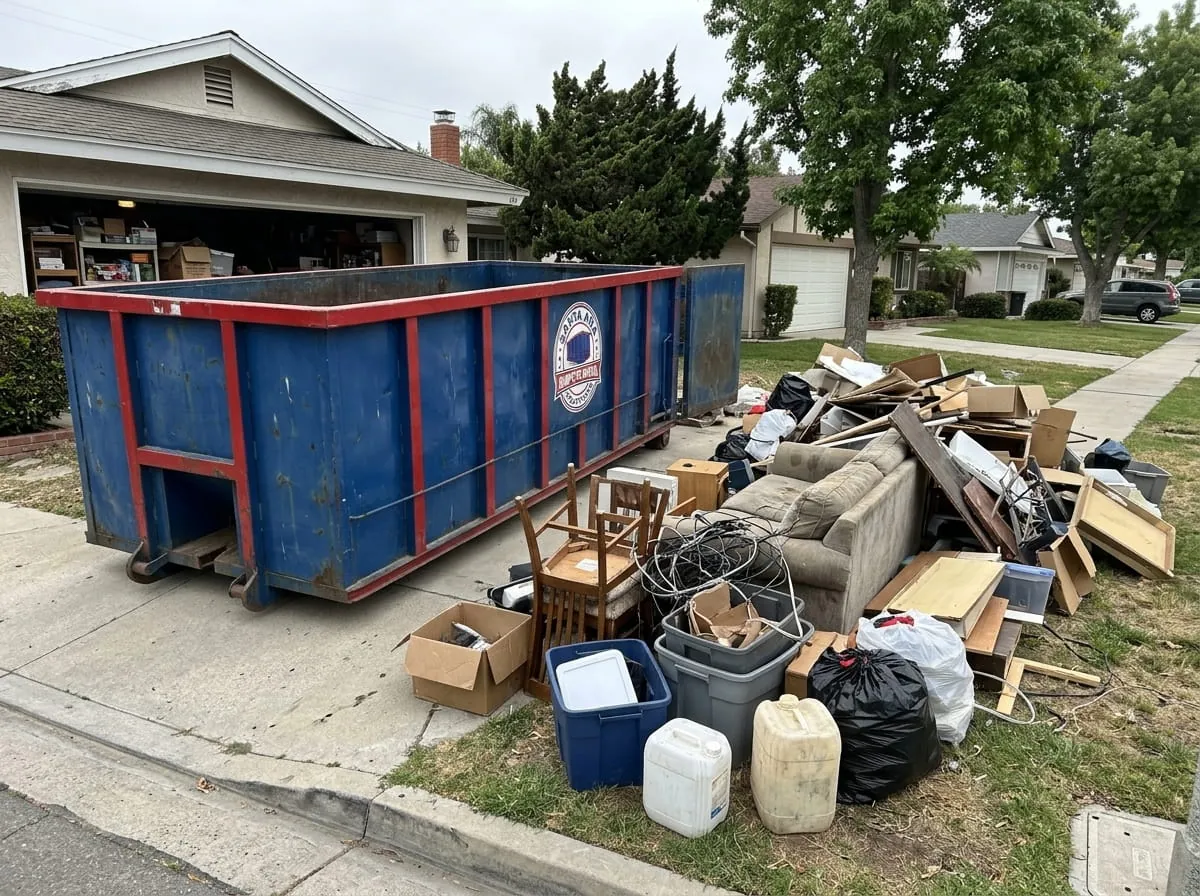
A two-car garage used for storage rather than cars holds an extraordinary amount, and because it is at ground level people mentally discount it: it looks like a room rather than a store.
⚠️ The second place is the yard. Lots here often carry a shed, a pergola, old fencing and decades of accumulated pots, paving and planting. And a good deal of that is treated wood, which has its own disposal route in California — worth identifying early rather than at the gate.
An order of work that holds up
Work from the least emotional to the most, and from the largest volume to the smallest.
1. Documents and valuables out. Before anything else.
2. The hazardous sort. Walk the property with a box and pull everything chemical, pressurized, electronic or battery-powered. Mostly garage and shed. Do this early — it is the one category that cannot be fixed later.
3. The garage. Biggest volume, least emotionally loaded, and clearing it gives you staging space for everything else.
4. The yard and any outbuildings. Same reasoning, and it surfaces the treated wood.
5. Kitchen, bathrooms, laundry. Functional rooms where decisions are easy.
6. Living areas and bedrooms. Furniture first, then contents.
7. Personal rooms and keepsakes. Last, deliberately, and not on the same day as anything else if you can help it.
The order is practical and it is also kind. By the time you reach the hardest rooms you have had a week of practice at deciding, and the house has space to sort in.
⚠️ Sorting into five streams, not two
Most people sort into keep and throw. Five streams is barely more work and it changes what the job costs.
Keep. Out of the house immediately, into a vehicle or a labelled corner.
Sell. Furniture, tools, collectables, working appliances.
Donate. Clothing, household goods, books, usable furniture.
Scrap metal. Appliances, bed frames, tools, pipe, wire. ⚠️ This stream matters more than people realize: metal is the heaviest ordinary thing in a house, so taking it out reduces the load weight more than any other single decision.
Container. Everything else.
Keep the five physically separate from the start. Re-sorting a mixed pile is the single most wasted effort in a cleanout.
⭐ What is worth more than it looks
In a hurry these go in the container and should not.
Tools. Hand tools and older power tools from a generation that bought them to last. Frequently the most valuable thing in the garage.
Solid wood furniture. Even damaged, even unfashionable.
Working appliances. Donation or resale; scrap if not.
Period fixtures. In the historic districts especially — original hardware, light fittings, doors, tile and windows from a 1920s house have a genuine salvage market, and on a permitted job salvage counts toward diversion.
Books, records and photographs. Slow to sort, occasionally valuable, impossible to recover once buried.
Jewelry and coins in unexpected places. Check containers, drawers, pockets and boxes before they go. It is not a myth.
⚠️ The hazardous material, and where it goes
Every long-occupied property accumulates the prohibited list, and a California garage accumulates a particular version of it.
Paint, solvent, pesticides and weedkiller, pool chemicals, motor oil and automotive fluids, propane cylinders, batteries of every kind, fluorescent tubes, old aerosols and pharmaceuticals.
In California the routes are well established: a statewide paint stewardship program for leftover architectural paint, universal waste collection for batteries and lamps, e-waste collection for televisions and computers, and county household hazardous waste centers for the rest.
⚠️ Two that catch people specifically. Refrigerators, freezers and air conditioning units hold refrigerant that must be recovered by a qualified technician — and an old property very often has a spare fridge in the garage that everybody forgot about. Treated wood from old fencing, decking or landscape timbers has its own California disposal route and is not a container item.
And on a pre-1980 house, if you encounter anything that might be asbestos or lead paint, stop and have it tested. Neither is worth guessing about.
Sizing the container for a full property
For an ordinary three-bedroom Santa Ana home with the contents of a long occupancy, a 20 yard is the starting point and a 30 yard is the realistic answer once the garage is included — if the driveway takes it.
⚠️ In the historic districts it frequently does not. On a narrow pre-war lot the honest answer is two 15 yard loads rather than one 30, and we would far rather tell you that than send a truck that has to leave again.
Keep the heavy material out of the house load. Concrete, pavers, tile and soil from the yard want their own small container, for all the reasons in the sizing guide. A house clearance is bulky and light; mixing yard hardscape into it wastes the capacity you are paying for.
Doing it from out of state
A good deal of estate work here is arranged by family living elsewhere, and it works well with a few things settled in advance.
Agree the placement precisely, with a photograph of the spot — and in an older neighborhood, a photograph that shows what is overhead. Agree access: who has keys, whether there is a gate or an HOA, whether anyone needs to be on site. Name one person who can authorize a swap without a conference call. Set a firm collection date rather than leaving it open, because an unattended container with an open end date tends to acquire other people's material.
Need a container in Santa Ana?
Call and describe the job. Three minutes on the phone gets you a size recommendation, a flat rate and a delivery window — and we will tell you if a smaller, cheaper container is the right answer.
Call (714) 360-0701