Construction
Debris on a Build: Phases, Sizes and Documentation
Santa Ana is built out, so almost every job here is infill, teardown-rebuild or deep remodel — and almost every one of them is permitted, which changes how you run the containers.
⭐ A built-out city means permitted work
Santa Ana is dense and essentially fully built. There is very little vacant land, which means nearly every construction job here is infill on an existing lot, a teardown and rebuild, an addition, or a deep remodel of an older house.
So on a Santa Ana build the containers are not just a tidiness decision. How you run them determines whether the diversion paperwork is straightforward or painful.
Debris arrives in phases, not all at once
The default approach is to put one large container on site at the start and let everyone throw everything in it until it goes. It works, and it is almost always both the most expensive option and the worst for a diversion figure.
A project produces three or four distinct waste streams, in sequence, with densities that differ by a factor of ten and recoverability that differs just as much. One container cannot serve all of them well.
Matching the box to the phase costs nothing extra in delivery and frequently saves on disposal, because each load is closer to a single material — which is exactly what both the weight limit and the diversion calculation reward.
The demolition phase
If anything is coming out first — an existing structure, a slab, a driveway, a block wall, a patio — this is the heavy phase and it should be its own container.
Concrete, block, masonry, stucco, tile and pavers are all dense, and on an older Santa Ana house so are plaster and lath. ⚠️ This is a 10 yard container, part-filled, and often several loads.
It is also the phase where cleanliness pays most. Clean concrete and masonry are almost entirely recoverable, so separating them improves the diversion rate and the weight position at the same time. On a driveway or patio tear-out this is the easiest 65% you will ever bank.
⚠️ And on a pre-1980 structure, demolition is when asbestos and lead turn up. Test before you start, not after it is in the box.
Framing and shell: the bulky middle
Framing, sheathing, roofing and the shell produce the classic construction mix: timber offcuts, panel, packaging, banding, broken sheet material and a great deal of cardboard.
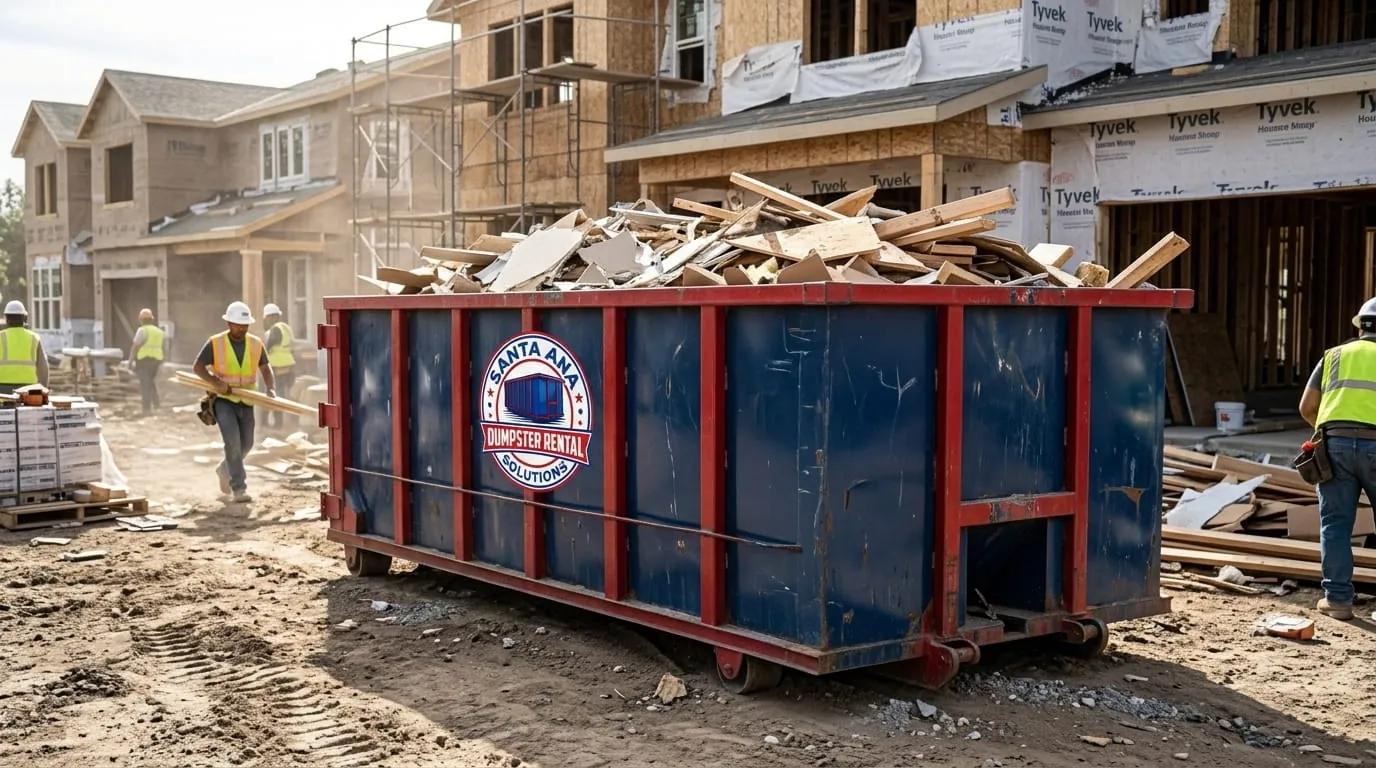
This is bulky and moderately light, which makes it a 30 yard phase where the lot allows one. Volume is the limit and the container fills to the rail long before weight matters.
Two things worth doing. Break down cardboard — packaging is an enormous share of shell-phase volume and flattened boxes take a fraction of the room. And keep clean timber separate if there is enough of it; on a larger build there usually is, and clean timber is recoverable in a way that timber mixed with drywall dust is not.
Roofing in this phase follows the roofing article: tile wants its own small container, shingle goes in with the shell waste.
⚠️ Finishes: light, messy and endless
The finishing phase produces the least weight and causes the most trouble.
Drywall offcuts and dust, flooring waste, trim, paint packaging, tile and backer board, fixture boxes, insulation scrap and an extraordinary quantity of wrapping. Light, bulky, and arriving steadily over weeks rather than in a burst.
A 20 yard usually covers it, but the characteristic problem is duration rather than size. A container standing for six weeks on a residential street in a dense neighborhood is a different proposition from one standing for four days.
⚠️ It is also the phase where prohibited material appears, because paint, solvent, adhesive, caulk tubes and aerosols all belong to finishing trades. Make that clear to everyone on site rather than assuming — a contaminated load costs money and can damage the diversion documentation at the same time.
⭐ Matching container to phase
A straightforward build looks like this:
Demolition: 10 yard, part-filled, as many loads as the material needs. Keep concrete and masonry clean.
Framing and shell: 30 yard where the lot allows, filled to the rail. Break down cardboard.
Roofing, if tile: its own 10 yard.
Finishes: 20 yard, with a swap if the phase runs long.
Final clean: 10 or 15 yard. There is always more than anyone expects at the end.
On a small remodel these collapse sensibly into one or two containers. On anything larger, running them as phases is cheaper, tidier and much better for the paperwork.
Site placement on a tight infill lot
Infill in a built-out city means the lot is usually small and the neighbors are close.
Put the container where the truck can approach straight and leave straight, with nothing overhead — and in the older neighborhoods the mature canopy is a genuine constraint, because a roll-off needs vertical clearance to tip.
Keep it clear of the delivery path for materials coming in. A container sitting where the lumber truck needs to be is a container that gets worked around badly for a month.
⚠️ If the lot genuinely cannot hold it and the container must occupy the street, that is the City's Public Works right-of-way review, including a traffic control plan, submitted through the City's electronic plan check. It carries a lead time. On an infill job in the historic districts, assume this will come up and raise it early.
⚠️ Keeping the documentation straight
On a permitted job the weight tickets are the deliverable, not a receipt.
Keep every ticket as it arrives rather than hunting for them at the end. Note which stream each belongs to while you still remember. Photograph loaded containers before they leave. Keep them in date order.
And nominate one person on site who owns the containers — what goes in, when they get swapped, and who to call. On the jobs where that is clear, contamination and overfilling essentially stop happening. On the jobs where everyone owns it, nobody does, and the diversion report is the thing that suffers.
Need a container in Santa Ana?
Call and describe the job. Three minutes on the phone gets you a size recommendation, a flat rate and a delivery window — and we will tell you if a smaller, cheaper container is the right answer.
Call (714) 360-0701